
| Title |
Panama Canal: 13th Labor of Hercules 1915 |
| Category |
| Booklet, gallery |
| Date |
1915 |
| Why It's Interesting |
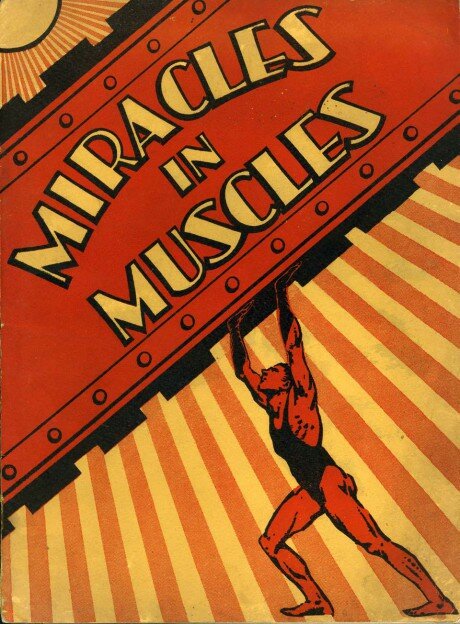
This catalog for the Panama-Pacific International Exposition, San Francisco, 1915, is one of the most prized images that I have posted. Prized by others, that is. [Though I also really like it.] I only obtained this after being far outbid on 2 other examples that previously appeared on ebay. One sold for over $100, probably because sought by collectors of homo-erotic imagery. Topical collectors usually outbid generalists like me, and collectors prize sexuality in items far more than they do historical significance. I almost never meet competition just because a piece has–at least to me–obvious documentary or aesthetic importance. I probably only obtained this one at a reasonable price because the cover is dirty. Most collectors prize condition in mass-produced collectibles above all other qualities because only condition exalts one copy above others, but of course condition is all but irrelevant for something’s documentary value. This design by Perham Wilhelm Nahl (1869-1935) was highly regarded in its time and can be found posted on several websites. One is selling 20″ x 30″ giclee prints, in an edition of 95, for $395 unframed. Nahl was the son of painter Arthur Nahl and became a professor of art at the University of California and founded the California College of Arts and Crafts. Hercules also refers to a tugboat built in 1907 that brought to Panama much of the heavy equipment used in digging the Culebra Cut. |
This website seeks to encourage researchers and collectors to discover and study obscure ephemera that document American culture and life. Worldcat reveals that most of the items that I post cannot be found in more than a few research libraries–often none at all. Alternately, research libraries do not bother to catalog ephemeral publications like these. I believe, however, that because these were distributed free, or at nominal cost, to consumers, they were the publications most likely to make their way into homes and be read by large numbers of Americans.
I acquire pre-1960 examples of the kinds of publications that prove so useful when scholars study 19th-Century America. The limited competition that I encounter for them suggests that libraries, which could easily outbid me, have little interest in post-Civil War and 20th-century ephemeral publications in general.
I try to anticipate what materials future historians will find useful. Being an historian first and a collector second, I organized this website to encourage others to do this too—even if this means new competition for me. I am aware that I could be wrong in prizing particular ephemera or even whole classes of ephemera. I may even be wrong to encourage scholars to study obscure ephemeral publications; these may be obscure for good reason.
Ephemerastudies.org will permit me to share with others the information and imagery that I am acquiring, and to benefit from the knowledge, intelligence and experience of other scholars and collectors. Please contact me with your impressions of the site.