
| Title |
Belgian Congo at 1939 New York World’s Fair |
| Category |
| Booklet, gallery |
| Date |
1939 |
| Why It's Interesting |
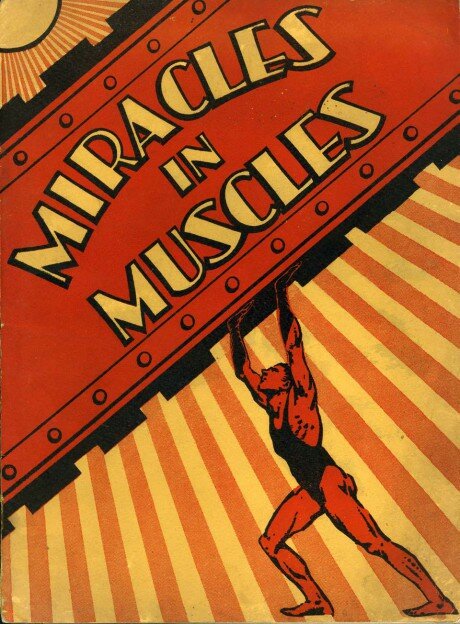
This striking booklet was issued at the Belgian Congo pavilion of the 1939 New York World’s Fair. [It is one of more than 100 items from that fair that I acquired recently, all collected by an ex-pilot who visited everything there and collected and saved unbelievable handouts.] The Congo was run then, of course by tiny Belgium, assigned to it because the great European powers were afraid to let one or another of them control this vast and minerally-rich area. Innocuous Belgium became the most tyrannical and cruelest of all of the overlords in Africa, and the Congo is still paying for this. [Just this morning I happened to read that rebel factions there fund themselves by mining and selling the space-age materials crucial for laptops, mobile phones, etc., of which the Congo happens to be the richest source. This booklet reminds one of National Geographic then, with exposed females, stereotypes pygmies and giants, and bygone names like Rhodesia and Afrique Equatoriale Francaise. Travelers were told to inquire at the Office National du Tourisme de Belgique, this being itself a relic of an age when French dominated official Belgian life, rather than now being a language despised by the majority Flemish and Walloon populations. |
This website seeks to encourage researchers and collectors to discover and study obscure ephemera that document American culture and life. Worldcat reveals that most of the items that I post cannot be found in more than a few research libraries–often none at all. Alternately, research libraries do not bother to catalog ephemeral publications like these. I believe, however, that because these were distributed free, or at nominal cost, to consumers, they were the publications most likely to make their way into homes and be read by large numbers of Americans.
I acquire pre-1960 examples of the kinds of publications that prove so useful when scholars study 19th-Century America. The limited competition that I encounter for them suggests that libraries, which could easily outbid me, have little interest in post-Civil War and 20th-century ephemeral publications in general.
I try to anticipate what materials future historians will find useful. Being an historian first and a collector second, I organized this website to encourage others to do this too—even if this means new competition for me. I am aware that I could be wrong in prizing particular ephemera or even whole classes of ephemera. I may even be wrong to encourage scholars to study obscure ephemeral publications; these may be obscure for good reason.
Ephemerastudies.org will permit me to share with others the information and imagery that I am acquiring, and to benefit from the knowledge, intelligence and experience of other scholars and collectors. Please contact me with your impressions of the site.